
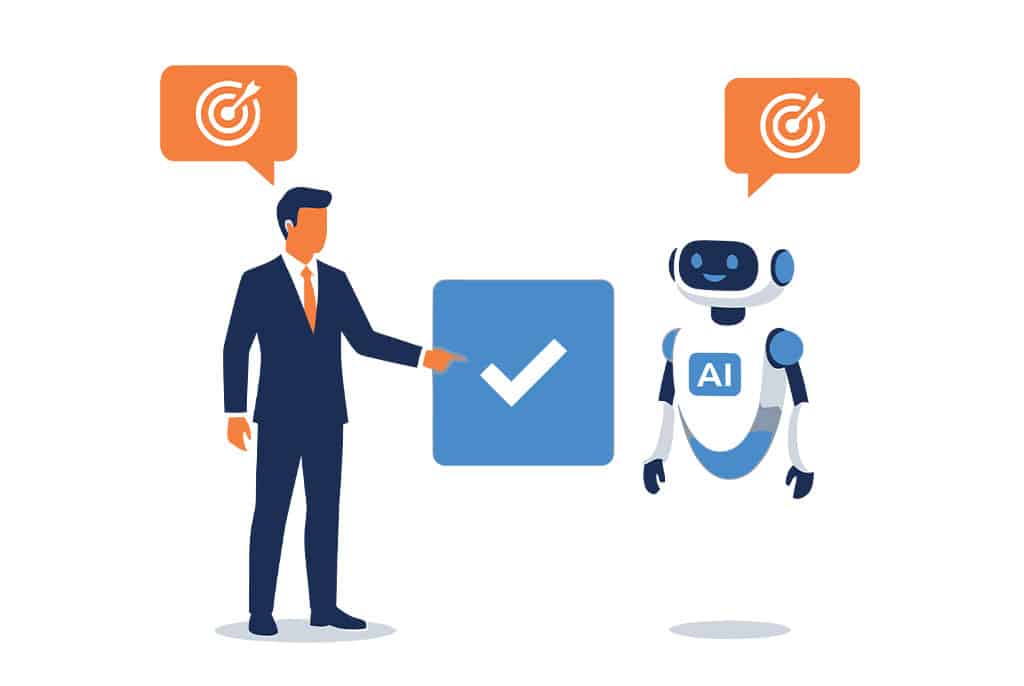
Business Plans Without AI Are Already Obsolete
Most CEOs (76%) use generative AI regularly. But few are planning for it.
For many, AI is just a tool deployed in pockets, like individual workflows and workgroup projects. Few have embedded it into their planning process as a structural requirement. But competitors are beginning to do this — and customers expect it. Every planning cycle that passes without addressing it widens the competitive gap. And that gap between operational AI adoption and strategic AI integration is where the real risk lives.
The Problem Isn’t the Plan; It’s What Comes After
In Vistage’s latest survey of over 1,000 CEOs, execution emerged as one of the biggest challenges. Indeed, 64% of leaders expect revenue growth in the next 12 months, yet only 48% expect improved profits. Costs are rising faster than pricing can keep up.
CEOs are consumed by tactical firefighting — managing disruptions, fielding customer demands, responding to unexpected policy shifts and so on. Time and bandwidth to fully engage in short- and long-term planning disappear. Alignment breaks down across leadership, management, and frontline teams.
Without clear accountability for who owns what, cascading goals become even more difficult and execution drifts off course. Most plans lack sustained focus — initiatives aren’t connected to how success gets measured or who’s accountable for moving them forward.
At the same time, AI has emerged as a real opportunity to address these challenges. The long-term role of AI might not yet be determined, but its impact has been immediate. That’s why CEOs need an AI governance policy built into the business plan itself with clear rules about which tools are sanctioned, how data gets protected and how AI is used. Without clarity on where AI should be embedded as a core planning component, execution gaps only widen.
Built and refined by our community, Strategic Planning by Vistage offers a world-class framework to help you think clearly, align your team, and build a plan that can drive results. Start building today. (My Vistage login required.)
Where AI Belongs in Your Plan
Critically, AI must be evaluated strategically and planned for accordingly. It is not just a box to check within the business planning process. Rather, it should be incorporated across a minimum of 6 core planning dimensions:
Competitive Advantage. How could AI reshape differentiation? Or, more directly: How could competitors use AI to attack market position? AI’s ability to “Amazon” (or disrupt) virtually any business model can’t be underestimated. This forces the vulnerability question early, before it becomes a crisis.
Market Analysis. Customer expectations are already changing. How is AI reshaping what they want, and how they want to interact with businesses? New tools alter market position. Organizations that don’t account for this shift will find their brand promise outdated faster than anticipated.
Financial Planning. AI capabilities can power and evaluate investment plans, ROI models and long-term forecasts. But CEOs may be underestimating the investment required: continuous training, tactical workgroup projects, and strategic AI transformation. Be sure to budget for the work, not just the technology.
Workforce Strategy. Migration to the 2030 Workplace can’t be an afterthought. Job profiles and hiring criteria need to change. Recrafting job descriptions to require AI skills changes the dynamic of who you attract and how you retain them.
Operational Excellence. AI automates and redesigns processes, improving productivity for individuals and teams. Process redesign must precede tool deployment.
Governance. Data security policies, acceptable use guidelines, and approved tools need to be established, documented, and communicated with semi-annual review cycles. This is foundational. Every organization using AI at scale without governance is one data breach away from a crisis.
How CEOs Use AI as Thought Partners
AI can also be a valuable thought partner. CEOs are using it for research, intelligence and synthesis. They use it to evaluate, generate and pressure test concepts in real time. Recursive prompting such as “what am I missing” provides an objective critique as concepts evolve.
AI can sharpen ideas, inject adjacent concepts and frame key risks in ways human brainstorming alone might overlook. And while it will never replace the leadership team’s collective intelligence, it can become a valued thinker in the room.
Many CEOs also can use it for scenario planning and modeling. This matters when evaluating the impact of a surprise tariff, the cost of losing a key customer or how labor market fluctuations affect retention. AI can proactively assess new product launches across multiple economic scenarios or evaluate new market opportunities without consuming leadership’s time and bandwidth. Scenarios that could take days or weeks to model manually can be evaluated in hours.
Don’t wait for perfect clarity on AI’s role. The next planning cycle — whether quarterly or semi-annual — is where inserting AI needs to start. Leaders who embed AI across these six components now will find advantage with every cycle. Those who treat it as an afterthought will find themselves playing catch-up — if they aren’t already.
This article first appeared in Inc.